
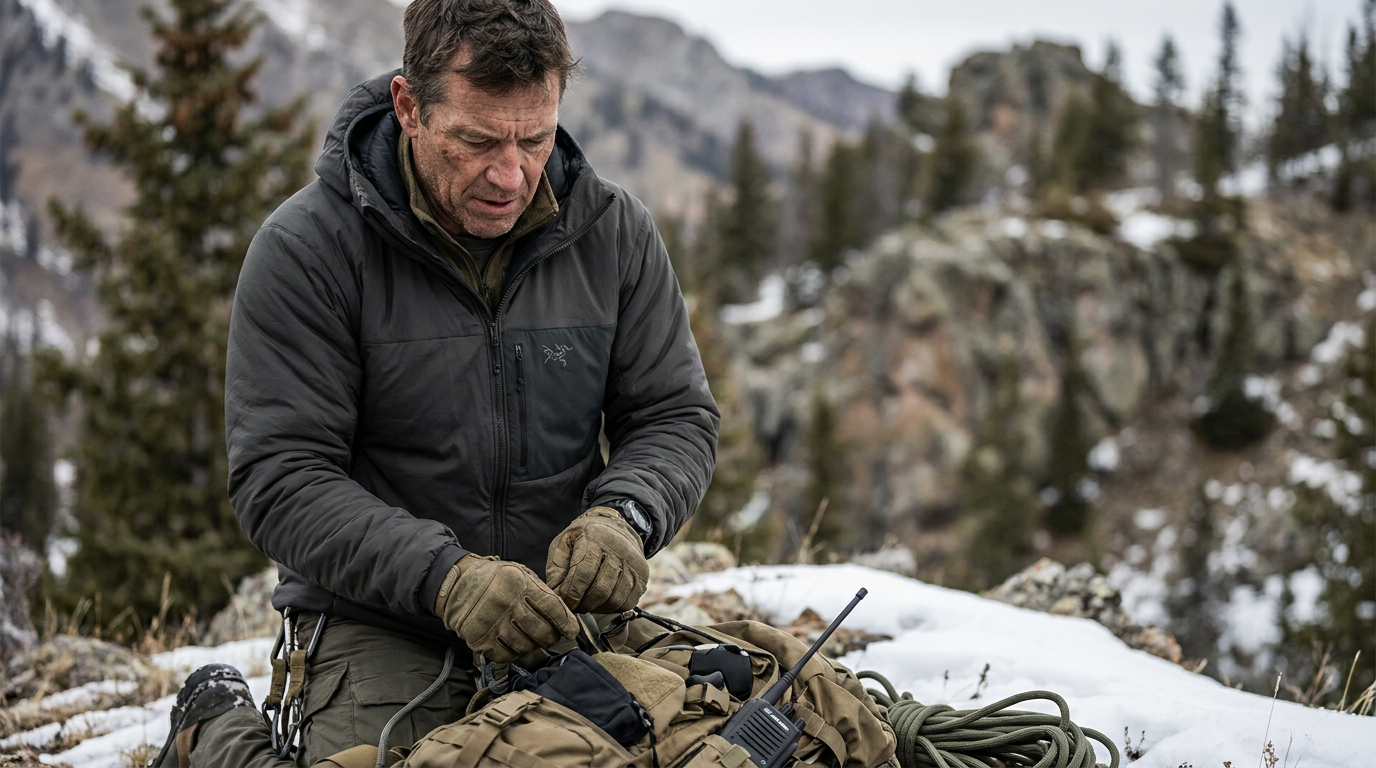
When outfitting for cold-weather operations, midlayers cannot be treated as a generic piece of kit. Mission profile, environmental saturation, sustained physical output, and static dwell time dictate exactly how thermal regulation must function. Within the tactical apparel ecosystem, two garments often draw direct comparison: the Arc'teryx PRO Cold WX Hoody LT Men's (Gen 2.1) and the Arc'teryx PRO Atom Hoody LT Men's (Gen 2.1).
While both garments utilize premium synthetic insulation to retain warmth in damp environments, they are engineered around fundamentally different tactical requirements. One prioritizes active breathability and low-bulk layering beneath armor or hardshells; the other serves as a hardened, wind-blocking outer layer designed to defend against convective cooling and freezing precipitation. Understanding the engineering nuances between these two platforms ensures you deploy with the exact protection your operational environment demands.
Core Design Intent: Active Ventilation vs. Environmental Protection
The primary operational difference between the Atom Hoody LT and the Cold WX Hoody LT lies in the balance between air permeability and wind protection.
The Arc'teryx PRO Atom Hoody LT Men's (Gen 2.1) is optimized for dynamic movement. Its primary mission is high-output thermal regulation in cold-to-temperate climates. The chassis incorporates air-permeable stretch fleece side panels running from underarm to hem. These panels act as mechanical heat dumps, allowing metabolic heat and vaporized moisture to exit continuously during heavy physical exertion, such as foot movement through broken terrain or weapon manipulation during dynamic clearing drills.
By contrast, the Arc'teryx PRO Cold WX Hoody LT Men's (Gen 2.1) is constructed to halt wind-driven thermal depletion. The outer shell uses a GORE-TEX INFINIUM™ (formerly WINDSTOPPER®) membrane that is entirely windproof and highly water-resistant. There are no exposed fleece panels on the Cold WX LT; the protective shell covers the entire torso and sleeves. When conducting static observation post (OP) surveillance, extended vehicle patrols, or maritime perimeter security where wind shear cuts straight through standard nylon, the Cold WX LT locks in dead air and completely prevents convective heat loss.
Insulation and Thermal Architecture
Both garments rely on Coreloft™ synthetic insulation, chosen for its structural resilience and ability to retain loft when damp, but the density and application methods vary.
- Atom Hoody LT: Utilizes Coreloft™ Compact 60g/m² in the torso. Compact insulation undergoes a special compaction process to reduce packing bulk by 50% without a proportionate loss in thermal yield. Because the insulation is targeted primarily at the core and paired with uninsulated fleece underarm panels, the Atom Hoody LT prevents the operator from overheating when operating at an elevated heart rate.
- Cold WX Hoody LT: Utilizes continuous-filament Coreloft™ insulation throughout the torso, arms, and hood. The insulation package is uninterrupted, providing consistent radiant warmth even when static. For prolonged exposure to freezing conditions or dry snow, this uniform thermal barrier preserves core body temperature far longer than an open-vent midlayer. For direct action missions requiring disruptive concealment, operators often deploy the pattern-matched Arc'teryx PRO Cold WX Hoody LT Men's – MultiCam (Gen 2.1) to maintain visual discipline without sacrificing thermal integrity.
Armor Compatibility and Tactical Features
How an insulated layer integrates with standard combat loadouts—specifically body armor, duty belts, and communications gear—is a decisive evaluation metric.
The Atom Hoody LT features an exceptionally trim profile. Its smooth, low-friction face fabric glides under plate carriers, chest rigs, and wet-weather outer shells without binding at the shoulders or bunching under the cummerbund. Hand pockets are low-profile, and the minimalist hood fits cleanly under tactical helmets or stows neatly against the neck when not deployed.
The Cold WX Hoody LT is built with a slightly more relaxed tactical fit to accommodate armor underneath in emergency static scenarios, though it is primarily worn over uniform blouses or mid-weight base layers. The feature set reflects exterior-use priorities:
- Upper Arm Pockets: Zippered sleeve pockets are fully accessible while wearing plate carriers, allowing access to mission-essential documents, IFAK supplies, or tactical communications.
- Cable Routing Ports: Integrated media ports inside the pockets allow comms wiring to be routed internally, eliminating snag hazards on vegetation, vehicles, or weapon slings.
- Adjustable Insulated Hood: The hood is fully insulated, adjustable with low-profile drawcords, and designed to move with the head rather than obstruct peripheral vision when worn over a combat helmet or soft cap.
Layering Strategies and System Integration
Neither garment operates in isolation; both function best as components of a deliberate environmental system.
If you build an active layering system around the Atom Hoody LT, pair it over a technical base layer or grid fleece. For high-output movements in cold terrain, wearing the Arc'teryx PRO Naga Hoody Men's (Gen 3.1) under an Atom Hoody LT provides an exceptional modular capability: the Naga handles moisture wicking and base insulation, while the Atom adds wind resistance across the chest while dumping vapor through the flanks. If heavy precipitation hits, a hardshell fits over the Atom with zero friction.
For low-output or sub-freezing operations, the Cold WX Hoody LT forms an outer thermal boundary. Starting with the heavyweight thermal foundation of the Arc'teryx PRO Cold WX Zip Neck SV Men's, an operator can layer directly into the Cold WX Hoody LT. This configuration creates an impermeable barrier against wind chill, trapping metabolic warmth inside the SV fleece and reflecting external cold through the GORE-TEX INFINIUM™ outer shell.
Mission Profile Decision Matrix
To determine which Arc'teryx PRO insulated layer you need, evaluate your typical duty requirements against these operational profiles:
Choose the Atom Hoody LT if:
- Your operational tempo consists primarily of dynamic, high-exertion movement (patrolling on foot, assault courses, mountainous ascents).
- The garment will be worn primarily beneath plate carriers or as an insulating midlayer under a wet-weather hardshell.
- Packability and weight minimization are critical, requiring an insulation layer that compresses down to fist-size in an assault bag.
- You operate in temperate-to-cool climates (30°F to 55°F) where overheating and sweat accumulation present greater hypothermia risks than external wind.
Choose the Cold WX Hoody LT if:
- Your mission involves significant static periods: observation posts, vehicle checkpoints, perimeter defense, or sniper hides.
- You operate in freezing conditions (below 32°F) exposed to sustained, biting winds and light frozen precipitation.
- You require standalone durability and utility, including accessible bicep pockets, comms ports, and hook-and-loop IFF patches.
- You need an immediate exterior "puffy" layer that can be thrown on quickly over armor or uniform during mission lulls to prevent rapid cooling.
Conclusion
The choice between the Arc'teryx PRO Atom Hoody LT and Cold WX Hoody LT is not a question of quality; both are built to the exacting standards required for tactical reliability. The decision rests entirely on your exposure profile. Select the Atom Hoody LT for an active, air-permeable midlayer that integrates seamlessly under duty armor during heavy physical output. Choose the Cold WX Hoody LT when absolute windproof performance, continuous thermal coverage, and mission-ready exterior utility are required to sustain combat effectiveness in austere, freezing environments.