Softshell vs. Hardshell: Which Tactical Jacket Do You Actually Need?
Quick Answer: What is the difference between a softshell and a hardshell?
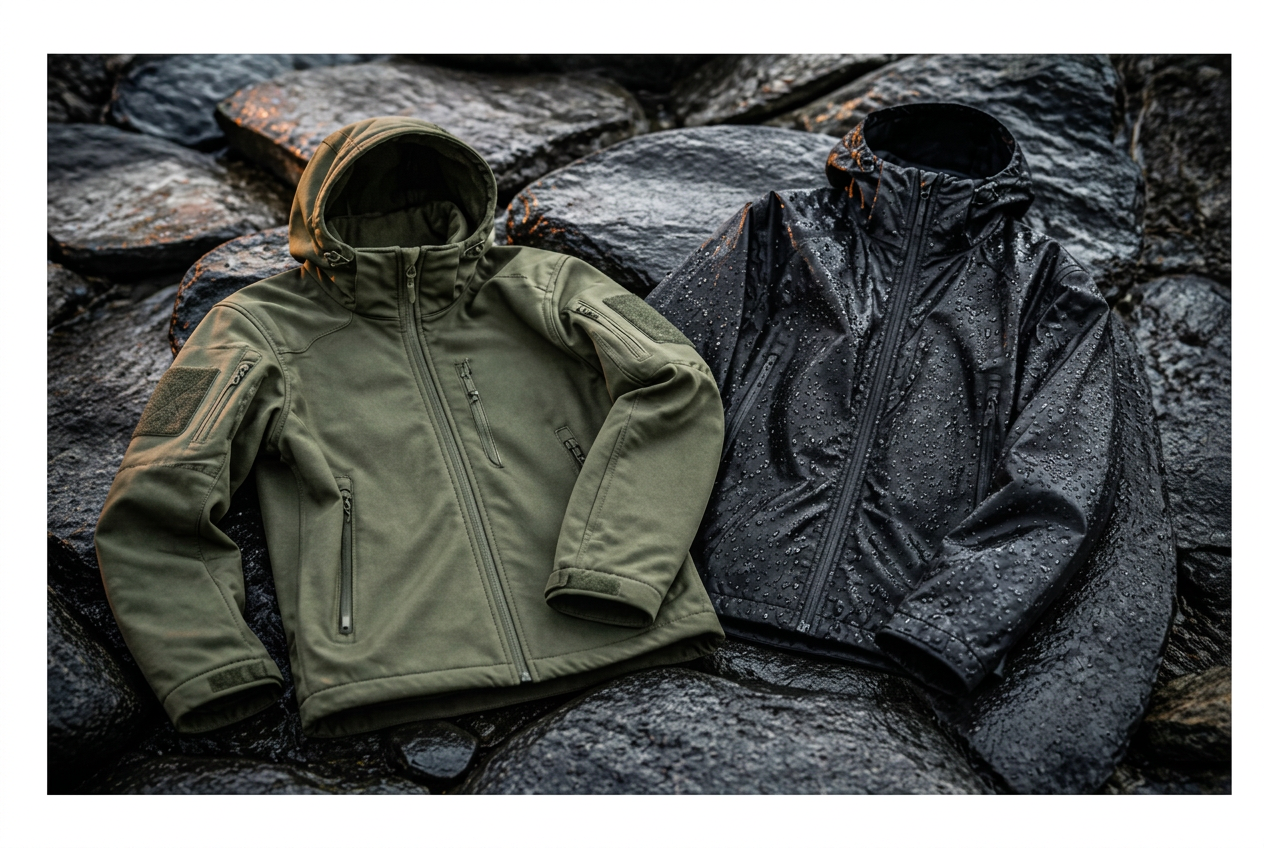
A hardshell is a fully waterproof, windproof outer layer built on a membrane like GORE-TEX PRO. It is your storm armor: it stops sustained rain, wet snow, and hard wind, and it packs down to almost nothing when the weather is dry. A softshell is an air-permeable, stretch-woven layer with a DWR finish. It breathes far better, moves with you under a plate carrier or pack, and shrugs off wind and light precipitation, but it will eventually wet out in a real downpour. If you sweat more than you get rained on, run the softshell. If failure means hypothermia, carry the hardshell.
The Wrong Layer Is a Mobility Kill
Most people buy a jacket for the worst day they can imagine and then wear it every day. That is backwards. The failure we see most often in the field is not a jacket that leaked. It is a jacket that never leaked and cooked the operator from the inside instead.
Moisture is moisture. Your body does not care whether the water soaking your base layer fell out of the sky or came off your own skin. A three-layer hardshell zipped to the chin during a 45-minute uphill approach will saturate you as thoroughly as standing in the rain, and then the wind will strip that heat right back out of you the moment you stop moving. Hypothermia does not require a storm. It requires wet insulation and a stationary body.
Choosing between shells is not about which one is better. It is a question of which failure mode you can afford on that specific task.
How a Hardshell Actually Works
A hardshell is a laminate. A face fabric takes the abrasion, a membrane blocks liquid water while allowing vapor to pass, and a backer protects the membrane from body oils and grit. GORE-TEX PRO is the reference standard in this category, and the current generation uses a PFAS-free ePE membrane without giving up durability.
Three details separate a professional-grade hardshell from a rain jacket:
- Seam sealing. Every stitch line is a hole. Fully taped seams are the difference between waterproof and water resistant.
- Hood architecture. A helmet-compatible hood that turns with your head keeps your peripheral vision. A hood that does not is a liability the first time you scan a corner.
- Venting. Pit zips and mesh-backed pockets are how you dump heat without opening the front and letting weather in. Vapor transfer alone will not keep up with sustained exertion.
Weight and packability matter here too. The modern hard shell exists to live in the top of your pack until the weather turns, which is why the good ones compress smaller than a fleece.
How a Softshell Actually Works
A softshell trades absolute weather protection for air permeability and stretch. There is no membrane blocking airflow, so warm, humid air moves out of the system continuously instead of queuing up behind a laminate. The woven face sheds wind and light snow, and a DWR treatment beads off drizzle long enough to get you to cover.
The operational advantages are real:
- Silence. Softshell fabric does not crinkle. That matters on approach and it matters in a hide.
- Range of motion. Four-way stretch under a plate carrier, a belt, or a 45-pound pack means the jacket is not fighting you on every shoulder movement.
- Abrasion resistance. A tightly woven softshell handles rock, brush, and webbing better than a lightweight laminate face fabric.
The tradeoff is honest and unavoidable: under sustained rain, the DWR wets out, the face fabric loads with water, and the jacket becomes cold, heavy, and slow to dry.
Decision Matrix: Pick by Task, Not by Season
Run a hardshell when:
- Precipitation is sustained rather than intermittent
- The temperature sits near freezing, where wet snow behaves like rain
- You will be static for long periods: overwatch, perimeter, vehicle security, range instruction
- You are operating far enough out that getting soaked has no recovery plan
Run a softshell when:
- The primary threat is wind and cold, not water
- You are working hard: patrol, movement over terrain, training evolutions, load carriage
- You need stretch and quiet more than you need a membrane
- Conditions are dry, cold, and variable, which is most of the year in most of the country
Run both when:
Most professionals do. The standard configuration is a softshell worn as the working layer with a packable hardshell staged in the pack. That combination covers roughly every condition short of full alpine, and it weighs less than one heavy insulated parka that only solves one problem.
Fit and Layering Under Kit
Size the shell around what goes under it. A jacket that fits perfectly over a t-shirt in a fitting room will bind over a grid fleece and a plate carrier. Check three things: can you reach full extension overhead without the hem lifting above your belt line, can you access your chest rig with the jacket zipped, and does the cuff seal over a glove rather than under it.
Keep insulation separate from your shell whenever you can. A fixed-liner jacket is one garment that solves one temperature band. A shell plus a discrete mid layer is a system that covers four.
Care: The DWR Is a Consumable
Both shells depend on a durable water repellent finish, and that finish is not permanent. When your face fabric stops beading and starts darkening, the jacket has not failed. It is dirty. Wash it with a technical cleaner, tumble dry on low to reactivate the finish, and reapply a wash-in or spray DWR once or twice a season depending on use. A neglected hardshell will feel like it leaks long before the membrane is anywhere near the end of its service life.
The Bottom Line
Waterproof is not the same thing as capable. A hardshell is the right answer to weather you cannot escape; a softshell is the right answer to work you have to keep doing. Decide which of those two describes the majority of your time on the ground, buy that jacket first, and add the other one when the mission calls for it.
Everything we stock is gear our staff has carried professionally. If you are not sure which side of this line your work falls on, reach out and we will talk it through before you spend the money.